
Blender Deep EXR: Breaking the Limits of 2D Render Layers in Nuke
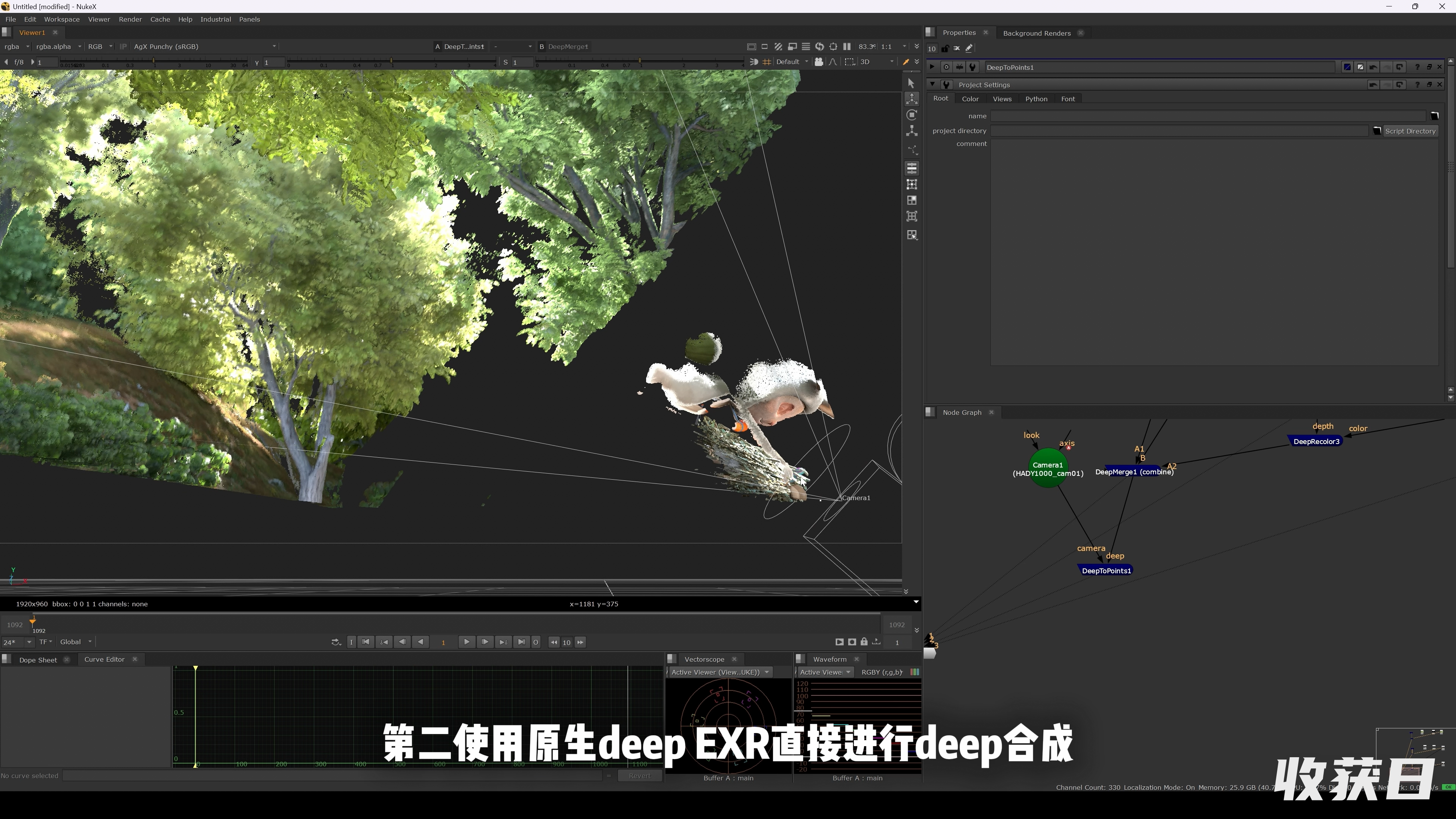
The core benefit of Blender Deep EXR is allowing complex, multi-layer CG renders to be recombined in Nuke according to true spatial relationships. Characters, environments, hair, smoke, particles, and fractured rigid bodies can be rendered independently, then composited with correct 3D occlusion during the comp stage. This minimizes various Holdouts between Render Layers and avoids cascading re-renders triggered by element updates.
Traditional CG Layering Requires Premature Holdout Locking
Feature-film VFX shots are typically composed of multiple independent render tasks. Characters might come from a Character Layer, the environment from an Environment Layer, while smoke and particles are submitted separately by the FX department. Hair, glass, or digital doubles might also have their own dedicated render versions.
In a traditional 2D layering pipeline, the occlusion relationships between elements must be locked in advance:
- The character layer needs to include holdouts for the environment or foreground objects;
- Smoke layers must match the mattes of characters, props, and environments;
- Particles need to be split into multiple Render Layers based on depth sorting;
- If a background asset changes, the related foreground layers might need to be resubmitted;
- When adding new CG elements, the occlusion configurations of all existing layers must be updated synchronously.
When a shot involves heavy cross-movement, semi-transparent edges, and volumetric elements, these dependencies spread rapidly. A single asset version bump can trigger multiple rounds of rework across Lighting, FX, and Comp.
Deep EXR Preserves Spatial Samples Inside Pixels
When a standard image is output, all visible content within the current pixel is flattened into a final RGBA result. Once flattened, the original depth hierarchy inside the pixel is incredibly difficult to adjust.
Deep EXR allows each pixel to store a variable number of samples. Each sample carries color, Alpha, and its corresponding depth information. Therefore, a single pixel can simultaneously record foreground hair, a character's surface, volumetric smoke, particles, and a distant environment.
In professional renderers like Arnold, RenderMan, and V-Ray, Deep output has long been used to deliver surfaces, transparencies, and volumes to feature-film compositing pipelines. Industrial CG Platform brings this mature Deep EXR workflow to Blender and Cycles.
Industrial CG Platform generates Deep data directly during the Cycles rendering process and outputs Deep EXRs that can be natively read by Nuke's DeepRead node. Spatial relationships are delivered alongside the render result, keeping complete recombination capabilities intact during the compositing phase.
Recombining Independent CG Layers in Nuke
The most straightforward workflow is connecting the Deep EXRs delivered by various departments into a DeepMerge node. Nuke processes the occlusion based on the spatial position of each Deep sample, and finally flattens it into a standard 2D image via a DeepToImage node.
DeepRead_Character ───┐
DeepRead_Environment ─┤
DeepRead_Volume ──────┼─ DeepMerge ─ DeepToImage
DeepRead_Particles ───┘
An alternative workflow utilizes DeepRecolor, writing independent 2D RGBA render results into their corresponding Deep samples. Color and spatial data can be delivered separately and recombined in Nuke.
Read_Character ──────┐
DeepRead_Character ──┴─ DeepRecolor_Character ───┐

Read_Environment ──────┐                          │
DeepRead_Environment ──┴─ DeepRecolor_Environment ┤

Read_Volume ──────┐                                ├─ DeepMerge
DeepRead_Volume ──┴─ DeepRecolor_Volume ──────────┤      │
                                                   │  DeepToImage
Read_Particles ──────┐                             │
DeepRead_Particles ──┴─ DeepRecolor_Particles ────┘
Compositors can insert smoke between a character and the environment, add particles behind foreground hair, or swap out background assets entirely. As long as each layer retains valid Deep samples, Nuke can recalculate the occlusion relationships inside the pixels.
Render Layer splitting thus serves primarily for inter-department collaboration, sampling strategies, and version management, no longer restricted by fixed depth sorting.
The Biggest Payoff: Reducing Correlated Re-Renders in Complex Shots
Deep compositing offers limited benefits for simple shots. Its true value shines in complex shots where characters, hair, volumes, environments, and massive FX elements intersect simultaneously.
In such shots, Deep EXR can eliminate:
- Render Layers repeatedly generated for different occlusion orders;
- Dedicated holdouts required for every foreground element;
- Cascading re-renders triggered by asset position or version changes;
- Tedious manual roto for hair, smoke, and particle edges;
- The overhead of constantly syncing Matte versions across departments;
- Resubmitting existing render layers just because a new CG element was added.
For example, when a director asks to add a layer of smoke behind a character, the traditional pipeline might require recalculating the holdouts between the character, smoke, and environment. A Deep workflow allows you to directly drop the new smoke layer into the existing Deep comp, letting Nuke handle the spatial sorting.
When the Character Beauty is updated but the geometry relationships remain identical, DeepRecolor can write the new 2D result back into the original Character Deep samples, without needing to rebuild the entire multi-layer occlusion chain.
Preserving Adjustment Headroom for High-Complexity Shots
For shots featuring crowds, furry characters, volumetric effects, rigid body destruction, and multi-layered environments, Deep significantly lowers the cost of subsequent modifications.
Visit the official Industrial CG Platform homepage, download the current build or grab the source code from GitHub, and integrate Blender rendering into a Nuke deep compositing pipeline built for complex multi-layer CG assembly.